As an Amazon Associate, this website earns from qualifying purchases.
The short answer
For most PC simmers, Logitech's Pro Flight Rudder Pedals or Thrustmaster's TPR cover flying well at a reasonable size. If you need Xbox compatibility, the Thrustmaster TFRP or Turtle Beach VelocityOne Rudder are the pedals to check first.
Flight simulator rudder pedals are the add-on most new simmers buy after their first stick or yoke. Choosing between the five models below comes down to two questions. Does it need to work on a console? And how much sensor precision and build quality do you want?
#1. Logitech G Pro Flight Rudder Pedals: best all-around PC pedals
Keep in mind: they are Windows PC only, with no console listing.
Product details checked September 2026
Logitech's pedals center themselves. A tension dial sets how hard the rudder pushes back. Split toe brakes let you brake the left and right wheels on their own. They plug in over USB, and Logitech lists an optional software download. This is a simple, proven set for general PC flight sims.
#2. Thrustmaster TFRP Rudder Pedals: best pedals for PS5 and Xbox
Keep in mind: the four-rail slide system takes some setup time to get feeling right.
Product details checked September 2026
The TFRP is listed for PS5, Xbox Series X|S and PC. That makes it one of the few rudder sets that covers console and PC from one box. It has a self-centering rudder axis with long travel. It slides on four aluminum rails, using Thrustmaster's S.M.A.R.T system, built for smooth, low-friction motion.
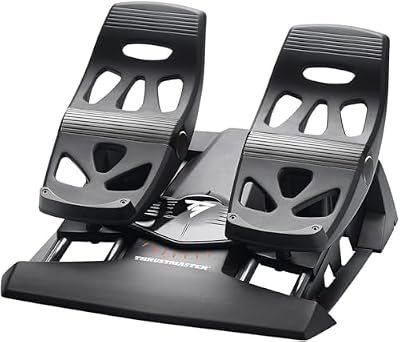
#3. Thrustmaster TPR Rudder Pedals: best hall-effect pedals for PC
Pendular (suspended) mechanism for smooth rudder travel
Hall-effect magnetic sensors
Adjustable resistance with two springs and several positions
PC only
Keep in mind: it is PC only, with no listed console support.
Product details checked September 2026
The TPR swaps Thrustmaster's usual slide rails for a hanging pendulum mechanism. It reads position with Hall-effect magnetic sensors instead of potentiometers. Two springs and several settings let you tune how hard the rudder pushes back. It works on PC only.
#4. Honeycomb Charlie Rudder Pedals: best pedals to match a Honeycomb yoke and throttle
Hall-effect sensors, with left and right toe brakes
Adjustable foot angles, grip strips and carpet spikes
PC and Mac; Xbox needs the Honeycomb Xbox Hub
Keep in mind: Xbox needs the separate Honeycomb Xbox Hub, since Charlie does not connect to a console on its own.
Product details checked September 2026
Charlie has an aluminum build with a belt drive. It uses Hall-effect sensors and has left and right toe brakes. You can adjust the foot angle.
Grip strips and carpet spikes keep your feet and the pedals planted during hard inputs. It works on PC and Mac directly. Xbox needs the separate Honeycomb Xbox Hub adapter.
#5. Turtle Beach VelocityOne Rudder Pedals: best pedals for Xbox and PC together
Keep in mind: swappable spring sets add a small setup step compared to a single fixed-tension pedal.
Product details checked September 2026
Turtle Beach's VelocityOne Rudder uses Hall-effect sensors on every axis. Swappable springs and two sets of pedals change how it centers and feels. It also has split brakes, and you can adjust the pedal width. It is listed for Xbox and Windows PC.
Factors to consider when choosing flight simulator rudder pedals
Sensor type is the real quality signal
Hall-effect sensors are used in the TPR, Charlie and VelocityOne Rudder. They read position without contact. That resists the wear that contact-based sensors can develop over years of use. If you fly casually, a set without Hall-effect sensors will still last a long time.
Console compatibility narrows the field fast
Only the TFRP and the VelocityOne Rudder carry a console listing here. The TFRP covers PS5 and Xbox, and the VelocityOne covers Xbox. Charlie reaches Xbox only through its separate hub.
The rest are PC only. That covers Logitech's pedals and the TPR. Check the exact listing before you buy if you need a certain console.
Compact vs. full-size
Smaller pedals on slide rails take up less floor space. They suit a desk setup. Full-size sets give more travel and often a wider stance. That matters more if you are building a seated cockpit for long sessions.
When pedals start to matter
You can fly a long time with a twist stick for rudder. Pedals start to pay off when you taxi often, land in crosswinds or fly taildraggers and warbirds. They also help in helicopters, where you use the pedals almost all the time. Our helicopter sim controller guide explains why.
Who this is for
This guide is for simmers who have flown without pedals and are ready to add them. It also helps if you already own a set and are weighing an upgrade for Hall-effect precision or console support.
Verdict: which flight simulator rudder pedals to buy
For a simple, precise PC setup, the best flight simulator rudder pedals are Logitech's Pro Flight Rudder Pedals or Thrustmaster's TPR. Pick the Thrustmaster TFRP if you need PS5 or Xbox support. The Turtle Beach VelocityOne Rudder suits Xbox and PC together. Honeycomb's Charlie suits simmers already running an Alpha and Bravo.
FAQ
Do rudder pedals work on Xbox?
Only specific models. Thrustmaster's TFRP is listed for PS5, Xbox Series X|S and PC, and Turtle Beach's VelocityOne Rudder is listed for Xbox and Windows PC. Logitech's Pro Flight Rudder Pedals and Thrustmaster's TPR are PC only.
Are hall-effect pedals worth paying more for?
Generally yes if you fly often. Hall-effect sensors are contactless and resist the wear-related drift that potentiometer-based pedals can develop after years of repeated use. Thrustmaster's TPR, Honeycomb's Charlie and Turtle Beach's VelocityOne Rudder all use hall-effect sensors.
Can rudder pedals double as pedals for racing games?
These picks are built for flight simulation. Do not assume flight rudder pedals will replace a racing set: check that your driving game can use their axes and brake inputs first.
What's the difference between compact and full-size rudder pedals?
Compact pedals use shorter sliding-rail travel and take up less desk or floor space, which suits smaller rooms. Full-size pedals give more travel and often wider stance adjustment, which some simmers prefer for long sessions.