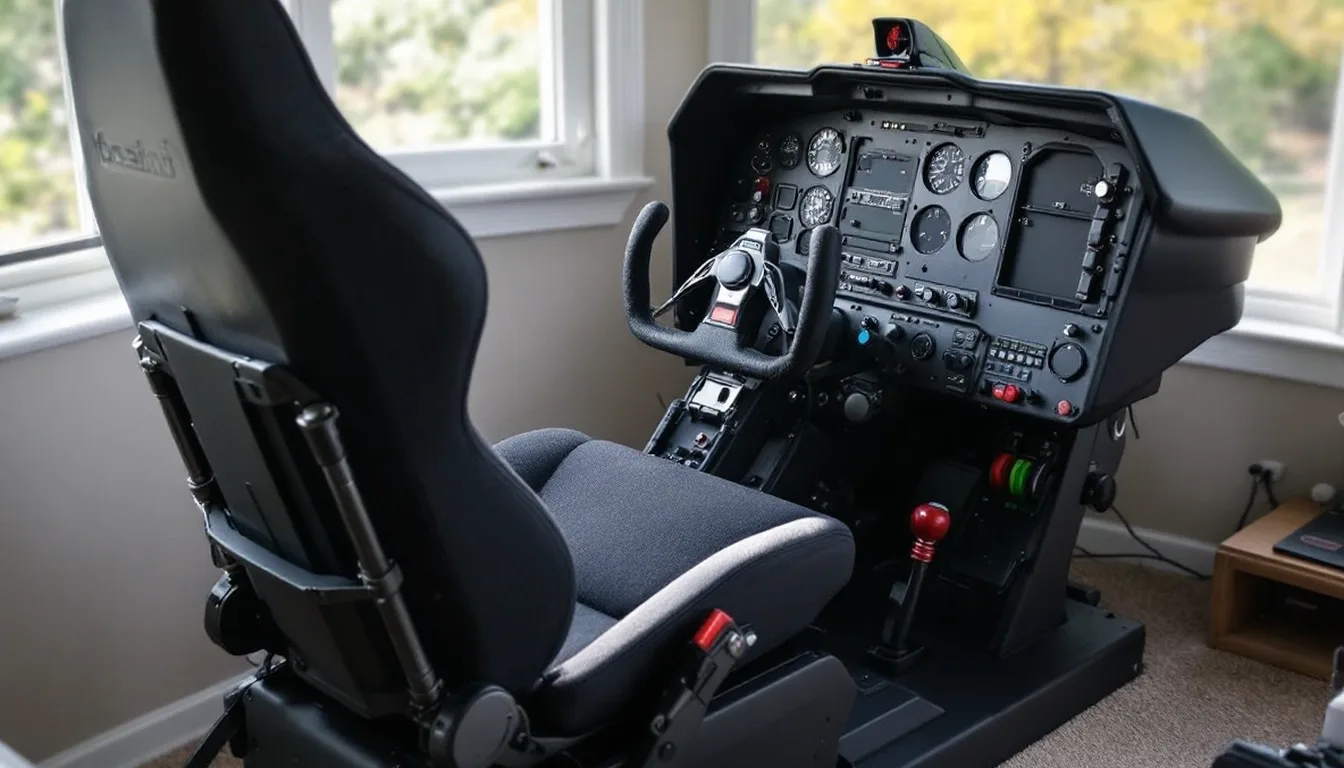
Next Level Racing Flight Simulator Cockpit: Two Frames Compared in 2026
As an Amazon Associate, this website earns from qualifying purchases.
The short answer
The Flight Simulator covers most single-seat setups in one purchase. Choose the Flight Stand Pro instead if you want a HOTAS-first, military-style layout you can build up in stages by adding the Flight Seat Pro later.
A Next Level Racing flight simulator cockpit comes in two main forms. The Flight Simulator is a complete seated frame in one box. The Flight Stand Pro is a HOTAS-first stand that you build into a full cockpit by adding the separate Flight Seat Pro. Both take yokes and HOTAS sets, plus throttles and pedals. They differ in how you buy into them and in the layouts they support.
Cockpit frame and seat, licensed by Microsoft Flight Simulator
Adjustable lumbar support in the seat
Mounting patterns for yokes, throttles and sticks from major brands
Controls not included
Keep in mind: controls are not included, and it is sized around a conventional single-seat layout rather than a military dual-stick setup.
Product details checked September 2026
Microsoft Flight Simulator licenses this frame. It ships with a seat that has adjustable lumbar support built in. Its mounting patterns fit yokes and sticks from the major brands, plus their throttles. Since the seat comes in the same box, you have no second product to buy before you sit down and fly. It is the simpler path if you just want one complete frame.
Center HOTAS pole that adjusts for height and angle
Rudder plate adjusts for angle, height and side-to-side position
Becomes a full cockpit with the Flight Seat Pro
Supports airliner, GA, helicopter, space and military layouts
Keep in mind: it is a stand, not a full seated cockpit, until you add the separate Flight Seat Pro.
Product details checked September 2026
The Flight Stand Pro centers on a HOTAS mounting pole that you can adjust for height and angle. Its rudder plate adjusts for angle and height, and it slides side to side. Next Level Racing says it supports airliner and general aviation layouts. It also lists helicopter and space setups, plus military ones. That is a wider range than the base Flight Simulator's more classic single-seat build.
On its own, the Stand Pro has no seat. Add Next Level Racing's Flight Seat Pro to turn it into a full cockpit. The seat brings its own HOTAS pole, a cut-out for a center stick and castor wheels that lock.
Next Level Racing flight simulator cockpit frames don't include controls
Neither the Flight Simulator nor the Flight Stand Pro comes with a stick, yoke, throttle or pedals. You buy the frame and its mounting points, and you supply your own controls. Next Level Racing says both fit yokes, joysticks, rudder pedals and throttles from the major brands. Still, check your exact hardware against the current fit notes before you order. Do the same as you would for any cockpit frame.
Fit and mounting to check on either frame
Both frames give general fit and mounting advice rather than one fixed spec. They are built to take gear from more than one brand. Before you order, measure your reach and leg length against the adjustment ranges for the seat, the arms and the rudder plate. Compare your stick or yoke's base with the mounting hardware each frame includes.
A frame that fits a typical adult well can still feel wrong at either end of the height range. Treat the published fit numbers as a starting point to check against your own body. They are not a promise.
Which Next Level Racing flight simulator cockpit to buy
If you want a single purchase that gets you into a seat with mounts ready to go, the Flight Simulator does that job directly. If you are building a military-style HOTAS setup, or would rather spread the cost over two purchases, start with the Flight Stand Pro. Add the Flight Seat Pro once you are ready to commit to a fixed seated position.
Neither frame is a wrong choice. The decision comes down to one box now, or a HOTAS-first build you finish in a second step.
What to check before ordering either frame
Past the choice between one box and a two-stage build, check the same details you would for any cockpit frame. Match each piece of your control gear against the stated fit notes. Then look at your floor space. A Flight Stand Pro without the Flight Seat Pro takes up much less floor space than a full seated frame. That matters if you aren't ready to give a whole corner of the room to a sim rig yet.
Who this guide is for
This page is for someone who has already chosen Next Level Racing. It helps you decide between the complete Flight Simulator frame and a build that starts with the Flight Stand Pro. If you are still comparing Next Level Racing with other brands, our cockpit kit page covers that wider comparison.
Verdict: Flight Simulator or Flight Stand Pro
Buy the Flight Simulator if you want one complete, licensed seated frame with nothing else to add. Buy the Flight Stand Pro if you want a HOTAS-first, military-style layout that you build up in two purchases. Add the Flight Seat Pro when you are ready for a seat. Either Next Level Racing flight simulator cockpit needs your own controls, so plan for those too. Our flight controller guide is a good place to start.
FAQ
What's the actual difference between the Flight Simulator and the Flight Stand Pro?
The Flight Simulator ships as one complete seated frame. The Flight Stand Pro is a HOTAS-first stand built around a center mounting pole and an adjustable rudder plate, with a separate Flight Seat Pro sold to complete it into a full seated cockpit.
Do these frames come with a stick, yoke or pedals included?
No. Both are frames with mounting points; you supply your own yoke, HOTAS, throttle and pedals. Next Level Racing lists general support for major control brands on both.
Which one supports more flight-layout types?
The Flight Stand Pro is explicitly built to support airliner, GA, helicopter, space and military configurations through its adjustable HOTAS pole and rudder plate. The base Flight Simulator is built around a more conventional single-seat GA and airliner layout.
Who is the base Flight Simulator for versus the Flight Stand Pro?
The base Flight Simulator suits a single, fixed setup bought as one product. The Flight Stand Pro suits someone who wants to start with HOTAS mounting now and add a proper seat, the Flight Seat Pro, once budget allows.